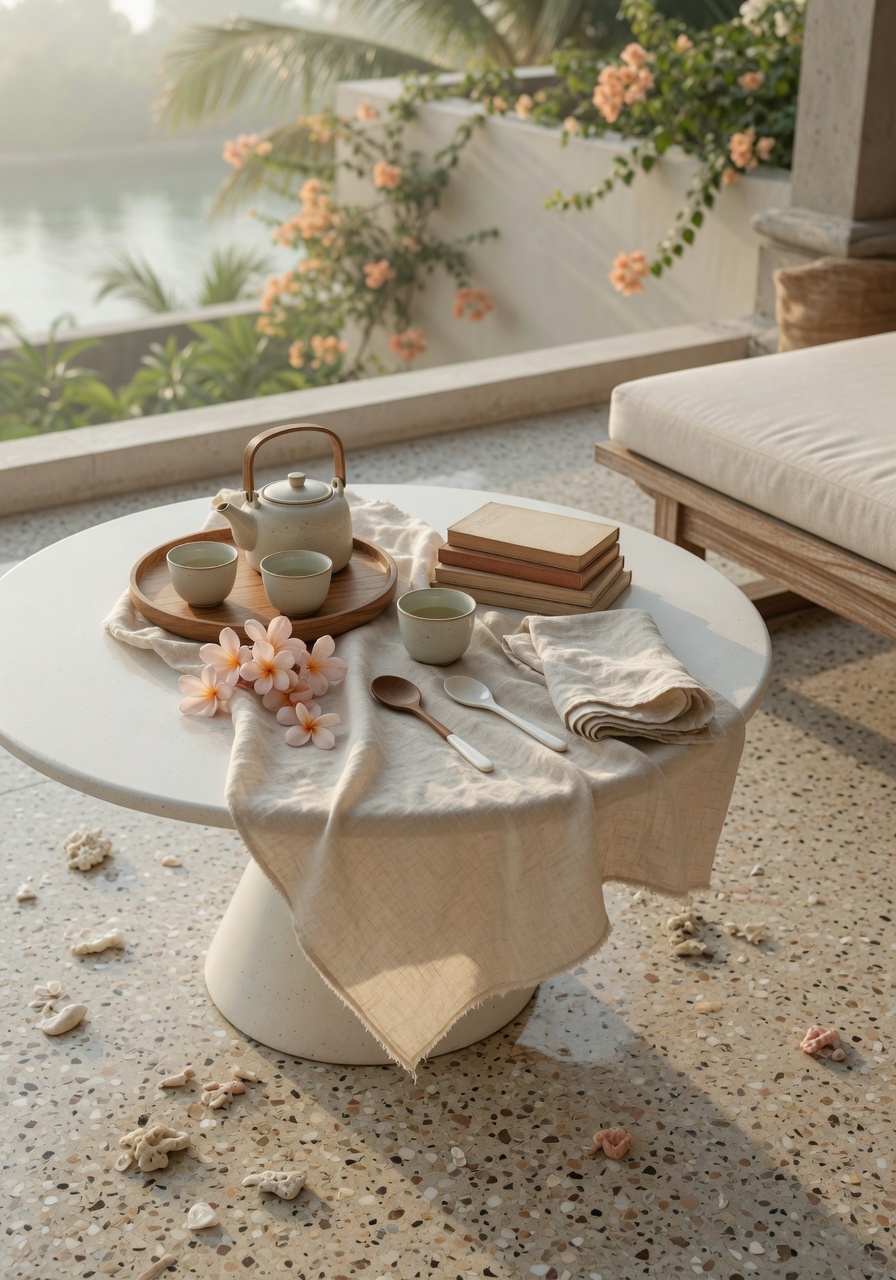
A quiet east-coast house given over to white tea — *Bái Háo Yín Zhēn* (白毫银针), *Shòu Méi* (寿眉), aged *Lǎo Bái Chá* (老白茶) — poured by Chen Hui Yi at the lagoon edge.
a white house on a still coast
Sanur sits on the leeward side of the island, where the reef holds the swell a kilometre offshore and the lagoon stays glassy until mid-morning. Villa Yínzhēn was built into the third row back from the beach path, behind a low wall of weathered paras stone and a hedge of frangipani that drops petals onto the gravel through the night. From the gate, a covered walk of polished terrazzo leads past a lap pool to the main pavilion — four bedrooms in a single storey, arranged around a central courtyard where a single old kamboja tree filters the light into something close to the light inside a paper window in Fújiàn.
The tea room occupies the eastern wing and opens directly onto the lagoon-side terrace through three panels of bronze-framed glass. The floor is pale lime-washed teak; the table is a single plank of suar wood, sanded but not lacquered, so the grain still catches a fingernail. There are eight seats — four low cushions on the lagoon side, four cane chairs against the inner wall — and a side console for kettle, gaiwan, and the small porcelain pitchers that Chen Hui Yi prefers for white tea. A standing rack of unglazed jars holds the house pressed cakes, each wrapped in cotton paper with the harvest year written in pencil. The room smells faintly of the aged Lǎo Bái Chá (老白茶) that lives in the largest jar — honey, dried longan, something close to old library wood.
Chen Hui Yi keeps a routine that the house tends to take on. She walks the beach before six, while the lagoon is still flat and the fishermen are pushing their jukung out through the channel. By seven she is at the table with the day’s first session — usually Bái Háo Yín Zhēn (白毫银针) from the Fúdǐng hills she’s worked with for over a decade, poured into a tall glass so guests can watch the silver needles stand vertical in the water before they sink. She writes notes for an hour after — some of them appear later on puerh.app and on the tea.school journal, where she contributes the white and yellow tea curriculum.
The four bedrooms are quiet. Each has a king bed dressed in unbleached linen, a stone-floor outdoor shower, and a small writing desk with a thermos of cooled Shòu Méi (寿眉) replenished twice a day by the housekeeper. The two lagoon-facing rooms catch the sunrise directly; the two courtyard rooms are darker and slightly cooler, which guests sleeping off long flights tend to prefer. There is no television in any of them. There is a small library off the corridor with about two hundred books, a turntable, and a basket of brewing equipment from tea.equipment for guests who want to practise alone in the afternoon.
The kitchen is staffed but unobtrusive — breakfast is laid out at the lagoon table from seven, lunch is on request, and the cook will prepare a quiet dinner of grilled fish and lawar greens if you don’t want to walk into Sanur’s older streets. The villa keeps an account with a driver in Renon for trips north to Ubud or south to the airport, and the concierge can arrange a private boat to Nusa Lembongan from the beach in front of the house.
This is a house for families, for two couples travelling together, or for a small group of friends who want the rhythm of a residency rather than a resort. It is calm in a way that the west coast of the island can no longer offer — Sanur was the first place foreigners settled on Bali, and it has kept the slow tempo of an older holiday. The tea programme suits that tempo. White tea forgives a tropical climate the way few teas do, and Chen Hui Yi has built the residency around exactly that forgiveness.
the white tea residency
The programme is built for guests who are new to gōngfū brewing, or who have brewed for years but want to spend a week with one category in depth. Chen Hui Yi leads two sessions a day — one at seven, before the heat, and one at five, when the lagoon turns pewter. Attendance is open: come to both, come to one, come to neither and pour your own at the table. The cabinet is unlocked.
Mornings begin with fresh white tea. The house keeps three vintages of Bái Háo Yín Zhēn (白毫银针) — current spring, two years rested, and a 2019 from a single garden above Diǎntóu — alongside Bái Mǔ Dān (白牡丹) and a small allocation of Yuè Guāng Bái (月光白), the Yúnnán moonlight white that Chen Hui Yi sources through the same network she writes about on thetea.app. Brewing is done in glass and porcelain gaiwan at temperatures slightly lower than the textbook — 82 to 85°C — to keep the needles from over-steeping in the humidity. Guests learn the weight of the lid, the angle of the pour, the moment when the leaves have given what they will give.
Afternoons turn to the aged side of the cabinet. Shòu Méi (寿眉) cakes from 2014 and 2016 are brewed in a small kettle on the side burner, the way they’re treated in Fúzhōu tea houses — long simmer, deep amber liquor, served warm in thick-walled cups. The 2008 Lǎo Bái Chá (老白茶), pressed into a 357g cake and stored dry these last sixteen years, comes out twice a week. It is the tea Chen Hui Yi uses to explain what time does to a leaf — the way the camphor note arrives, the way the sweetness deepens into something almost medicinal. Guests who want to take a cake home can choose from the rack; orders are filled through shop.thetea.app and shop.puerh.app and shipped to the home address rather than carried in luggage.
There are no exams, no certificates, no scheduled photographs. Children are welcome at the table — Chen Hui Yi keeps a small pot of cooled Shòu Méi (寿眉) for them and a bowl of dried longan to chew while the adults talk. Guests staying a full week usually find themselves brewing alone by the fourth morning, which is the point. The residency is published in the tea.travel calendar and tea.events listings; private bookings outside the public programme can be arranged directly with the villa.
Amenities
-
Eight-seat tea room with bronze-framed lagoon doors and a suar-wood table
-
Lap pool and shaded terrazzo terrace facing the lagoon
-
Four king bedrooms with linen dressings and outdoor stone showers
-
Small library with turntable and brewing kit from tea.equipment
-
Beach access through a private path to the Sanur reef lagoon
-
Daily housekeeping, staffed kitchen, and a driver on call in Renon
-
Air conditioning in all bedrooms; ceiling fans throughout the public rooms
-
Filtered soft water dedicated to the tea room
What’s included
-
Two daily tea sessions led by Chen Hui Yi (seven and five)
-
Open access to the white tea cabinet between sessions
-
Breakfast each morning at the lagoon table
-
Welcome tin from the Teamotea house selection
-
Private boat transfer arrangement to Nusa Lembongan on request
-
Airport pickup and return in a private car
-
Concierge access to the tea.community Bali chapter and tea.events calendar