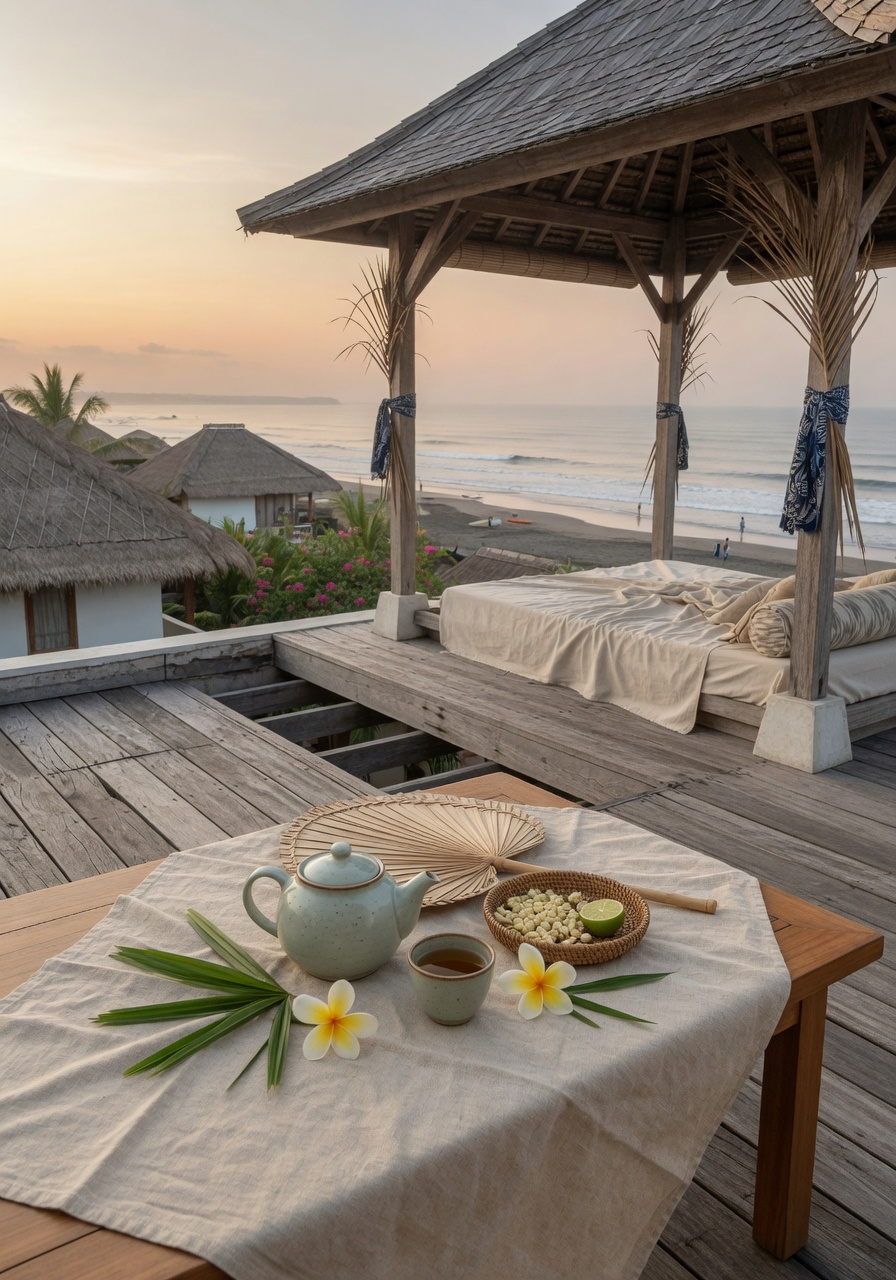
A four-bedroom house above the Canggu break, built around a rooftop pavilion where fresh Bulang Shan máo chá is poured each morning by resident master Fang Ting.
A house tuned to two things — the surf, and young sheng
Villa Bulang sits on the last quiet stretch of the Canggu coast, where the rice fields finally give way to black sand and the swell comes in long and unhurried. The house is four bedrooms across two low pavilions, joined by a teak walkway that runs past a lap pool and a frangipani court. Walls are limewashed in the pale colour of unbleached linen. Floors are old ironwood, oiled rather than lacquered, so the grain still moves under bare feet. Nothing is loud here. Even the front gate, hand-cut from a single recycled tembesu beam, opens without a sound.
The centre of the villa, though, is not the pool or the master suite. It is the rooftop pavilion — a thatched alang-alang structure on the third level, open on three sides, with a low tea table of weathered teak set facing the ocean. This is where Fang Ting works. She arrived in Canggu after a decade between Henan and the southern Yunnan mountains, and the pavilion was built to her brief: water station to the north so the wind does not carry steam across the guests, kettle on a small charcoal burner, gaiwan and pitcher within an arm’s length, nothing else on the surface. A single paper window of washi at the back filters the late afternoon light into something the colour of pale honey.
Guests stay in four bedrooms — two in the front pavilion facing the sea, two behind, set into the garden. The front rooms have outdoor showers walled in volcanic stone. The garden rooms are darker, cooler, designed for sleeping through the heat of the day. Each room has its own small tea tray with a Jianshui clay pot and two cups, restocked daily, so guests can brew alone before joining a session upstairs. Beds are linen on slatted teak frames. Air conditioning is present but rarely needed — the house was sited to catch the cross-breeze that runs from the rice fields down to the water.
A typical day at the villa moves slowly. Fang Ting opens the rooftop at seven for a quiet first session, usually a green or a young oolong drawn from her travelling chest. Breakfast follows on the ground floor — fruit from the Canggu morning market, fresh coconut, soft eggs, sourdough from a baker she trusts in Berawa. Mid-morning is unstructured. Some guests surf the break directly in front of the house, which is gentle enough on most days for longboards. Others read in the shade of the frangipani. Lunch is light and Indonesian — gado-gado, grilled fish, rice — served by the kitchen team who have been with the house since it opened.
The day’s principal tea session begins at four, when the sun has dropped behind the pavilion roof and the light on the table goes soft. This is the Bulang programme, the reason the villa exists in its current form, and it runs ninety minutes to two hours depending on the company. Fang Ting also keeps a working library of tasting notes which she contributes to puerh.app, and guests are welcome to follow along with her published cupping records on the platform. After the session, the staff lay out a long dinner on the terrace — usually a Balinese rijsttafel, occasionally a quieter Yunnanese menu when Fang Ting cooks for the table herself.
The surrounding environment is Canggu at its most settled. The villa is ten minutes by scooter from the Echo Beach cafes and the same from the older warungs of Pererenan, but the lane itself ends at the sand, and the only sound at night is the surf and the occasional gecko. The constellation team at tea.travel can arrange day trips inland — to the Jatiluwih terraces, to a ceramics studio in Ubud — for guests who want a counterpoint to the coast. Most do not feel the need.
Bulang Shan young sheng, poured fresh each month
Villa Bulang is built around a single varietal commitment: young sheng pǔ’ěr from Bulang Shan in southern Yunnan, drunk fresh rather than aged. Each month, máo chá from the spring and autumn pressings is flown in directly from a small producer Fang Ting has worked with since 2017. The leaf arrives loose, in foil-lined kraft, and is stored in a cedar chest in the rooftop pavilion. Guests see the wrapper, the harvest date, the village name on the side of the cake when a session is poured from pressed leaf.
Fang Ting runs two formats. The morning session, at seven, is short — twenty minutes, a single tea, brewed in a small Jianshui clay pot to soften the edge of a young sheng before breakfast. The afternoon session, at four, is the longer programme: a flight of three Bulang teas across a single tasting, moving from a lighter gǔshù máo chá (古树毛茶) through a pressed bǐng (饼) of two or three years, finishing with something more structured. Each tea is poured ten or twelve infusions in gōngfū (功夫) style, gaiwan to pitcher to small cups, with cooling water from the house filter held at the temperatures Fang Ting writes onto a small slate beside the table.
The character of Bulang itself is what she wants guests to learn. It is a forward, bitter-sweet tea — strong huígān (回甘), the returning sweetness at the back of the throat — and it rewards close attention. Fang Ting talks through the cup quietly, in English, sometimes drawing the leaf shape on the slate when a particular bud-and-leaf ratio matters. Her notes from these sessions appear on puerh.app under her resident profile, and the same Bulang teas she pours can be ordered for delivery to the villa through shop.puerh.app, so guests who connect with a particular pressing can take it home in sealed retail format.
Beyond the Bulang core, the pavilion carries a small working selection of Fang Ting’s other specialities — a Henan green from her home province, an aged Phoenix oolong from Guangdong, a yellow tea she rotates seasonally. These are available on request, particularly for guests who want a quieter morning cup. The villa is not a tasting room and the sessions are never timed against a clock. A flight may stop at the second tea if conversation goes long; it may run to a fourth if the company is curious. Children are welcome and are usually offered a single mild infusion of their own.
The tea room seats six comfortably around the low table, eight at a stretch. Larger groups split across the morning and afternoon. There is no charge for the daily sessions during a stay — they are included in the rate.
Amenities
-
Rooftop tea pavilion seating six, with charcoal kettle and Jianshui service
-
Four bedrooms across two pavilions, linen-dressed teak beds
-
20-metre lap pool and frangipani court
-
Direct beach access to the Canggu break
-
In-room Jianshui pot and cups in every bedroom
-
Outdoor volcanic-stone showers in the front pavilion
-
Resident kitchen team, Balinese and Yunnanese menus
-
Scooter and driver service to Pererenan and Berawa
-
Filtered still and sparkling water throughout the house
What’s included
-
Two daily tea sessions led by Fang Ting (morning and afternoon)
-
Monthly-fresh Bulang Shan máo chá and pressed bǐng (饼)
-
Breakfast and one main meal daily for all guests
-
Housekeeping twice daily and evening turndown
-
Airport transfer from Denpasar on arrival and departure
-
Surfboard storage and morning beach setup
-
Access to Fang Ting’s tasting notes on puerh.app during the stay